
Extractor fans
Clear the steam, properly.
The whole job, done by us: we supply the fan, core-drill the wall, run the ducting, fit the outside grille, wire it with an isolator, then test and certify it. Bathrooms, en-suites, kitchens and utility rooms, by DS Electrical Installations (SW) Ltd.
Send photos on WhatsApp →


 Part P
 BS 7671
What we fit
Every type of extractor fan, supplied and fitted.
We supply and fit every type of extractor fan: wall and window fans, ceiling fans ducted through the loft, inline fans for longer duct runs, and kitchen and utility units. Control is by timer or PIR and timer, so the fan runs while the room is in use and keeps going long enough afterwards to clear the steam, with nothing for you to set or forget.
Timer fans
Wired to come on with the bathroom light, or from its own switch, and run on for a set time after you switch off. The run-on time is adjustable, and we set it before we leave.
PIR and timer fans
A built-in movement sensor starts the fan when someone walks in, then the timer keeps it running after they leave. Useful in en-suites and WCs, and for anyone who forgets the switch.
Replacement fans
Old fan noisy, stuck or barely pulling? We swap it, and check the ducting behind it at the same time, because a crushed or disconnected duct is often the real problem.
Where the fan goes
Position matters as much as the fan.
The aim is to pull steam across the room and out, before it settles on cold walls and windows. We agree the position with you at the survey or from your photos.
- Bathrooms and en-suites: high on a wall or in the ceiling, near the shower or bath and away from the door, so fresh air is drawn in under the door and across the room.
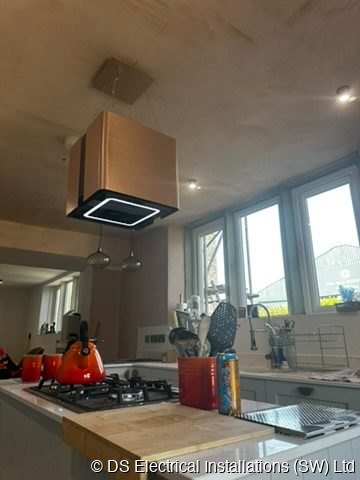
- Kitchens: on an outside wall or through the ceiling, near the hob. A cooker hood that vents outside does a similar job over the hob, and we wire those too.
- Utility rooms: near the washing machine and dryer, where the moisture is made.
- WCs and cloakrooms: a small fan, often on a PIR, so it runs whenever the room is used.
Ducting
Out through the wall or the roof.
A fan is only as good as the duct behind it. We take the shortest practical route to outside, with as few bends as possible, and finish it with a proper outlet: a wall grille or cowl through an outside wall, or a roof, tile or soffit vent when the fan is in a ceiling.
Through a wall, we core-drill a neat hole and seal the duct in. Somerset stone and thick rubble walls take longer to drill than brick or block, which is one reason every job is priced individually. Through the roof, we run the duct across the loft to the outlet and support it so it doesn't sag and hold water.
What we won't do is leave a duct ending in the loft. A fan that blows steam into the roof space just moves the damp somewhere you can't see it.
Safe and certified
Isolated, zoned, tested.
Isolator
Every fan gets a means of isolation, usually a fan isolator switch, so it can be turned off safely for cleaning or replacement without switching off the whole lighting circuit.
Bathroom zones
Bathrooms are split into zones around the bath and shower. The zone decides which fans are suitable, the IP rating needed, and where the switch and isolator can go. We check the zones and fit a model that suits the position.
The supply
Most fans take their supply from the room's lighting circuit. We check that circuit, and its protection at the consumer unit, before adding to it.
Test and certificate
We test the fan and the circuit, set the run-on timer, and give you the certificate. Work is notified to building control through our NAPIT registration where the rules require it.
Building Regulations, Part F. Ventilation is covered by Part F of the Building Regulations, with guidance in Approved Document F. It sets out extract ventilation for kitchens, utility rooms, bathrooms and WCs. When a kitchen or bathroom is refitted, it says any existing fan (including a cooker hood that vents outside) should be kept or replaced. In a room with no window that opens, the fan's controls should keep it running for at least 15 minutes after the room is left, and installers are asked to check that fans work, respond to their controls, and have any run-on timer set to at least 15 minutes. We set and check every fan we fit to that standard.
Source: GOV.UK, Approved Document F (ventilation), Volume 1: Dwellings, 2026 edition, paragraphs 1.47, 1.51, 3.30 and 4.15.Pricing
What affects the job.
Every job is priced individually. Send us a few photos and we can often quote without a visit; if we need to see it, we survey first and give you a fixed written quote.
- Whether the duct goes out through a wall or up through the roof
- The wall itself: brick, block, render or Somerset stone
- Loft access and the length of the duct run
- Where the supply and the isolator can come from
- Replacing an existing fan, or fitting one where there wasn't one before
Any plastering or decorating around new cable or switch routes is by others, unless it is written into your quote.
For a quote from photos
Send us these.
- The room, showing the ceiling and the outside wall
- Where you'd like the fan to go
- The existing fan, if there is one, and the outside of the wall behind it
- The loft above, if the fan will go through the ceiling
We cover Wells, Shepton Mallet, Glastonbury, Street, Frome, Bath, Bruton, Castle Cary, Midsomer Norton, Radstock, Wedmore and the villages between. All areas.
FAQ
Extractor fan questions.
Why does my fan keep running after I switch the light off?
That is the timer doing its job. A timer fan runs on after the light goes off to clear the steam still in the room. We set the run-on time when we fit it, and it can be adjusted.
Do you fit fans that come on by themselves?
Yes. We fit PIR and timer fans, which have a movement sensor that starts the fan when someone walks into the room. The timer then keeps it running after they leave.
Can you replace my old, noisy extractor fan?
Yes. We fit the new fan, check the duct behind it, and put right any duct that is crushed, disconnected or ending in the loft. A noisy or weak fan is often a duct problem rather than a fan problem.
Can a bathroom fan go through the roof instead of the wall?
Yes. Where there is no outside wall nearby, we fit the fan in the ceiling and run the duct across the loft to a roof, tile or soffit vent.
Do I get a certificate?
Yes. Every fan we fit is tested and certified, and the work is notified to building control through our NAPIT registration where the Building Regulations require it.
Which areas do you cover?
We fit extractor fans across Mid Somerset and Bath, including Wells, Shepton Mallet, Glastonbury, Street, Frome, Bruton, Castle Cary, Midsomer Norton, Radstock and Wedmore.
Get a quote
Get your fan fitted.
Tell us the room and where the outside wall or loft is, and we'll quote a neat, certified install.
- ✓ NAPIT registered & CHAS accredited
- ✓ Fully insured, every job certified
- ✓ Fixed written quotes
- ✓ Mid Somerset, Bath & surrounding areas
Thanks — that’s sent.
DS Electrical Installations (SW) Ltd will call you back to talk through the job.