
Generic case study. We do not name the property, the owners or the address, the value is the load planning, the dual-board topology and the no-surface-trunking discipline through original stone walls.
The brief
A barn of stone construction on the outskirts of Wells, recently converted to a 4-bed family home with a self-contained annexe used as a home office and occasional guest suite. The previous wiring was a barn-conversion legacy install, mixed dates, mixed standards, the original 60/80 A intake undersized for the customer's plans (ASHP heat pump going in the same year, EV socket plumbed for the next car). The brief: full rewire, future-proof the loads, and absolutely no surface trunking running across the original stone elevations the customer had paid to expose.
What we did
- DNO uplift to 100 A on the main intake to support ASHP, EV, induction kitchen and outdoor circuits without margin issues.
- Two consumer units, main board in the principal house utility, separate sub-board in the annexe via 16 mm sq SWA sub-main. Each independently isolatable.
- Hager metal-clad RCBO on both boards, Type A 30 mA RCBO per circuit, Type 2 SPD on the main incomer, AFDD on the principal-bedroom circuits per BS 7671 sleeping-accommodation guidance.
- Heat-pump circuit, dedicated 32 A radial in 6 mm sq T+E, Type A 30 mA RCBO. Type A is the correct selection for ASHP and domestic EVSE per BS 7671 and manufacturer guidance, not Type B.
- EV-ready socket, dedicated 32 A 6 mm sq radial run to the carport, Commando socket fitted, ready for a Hypervolt or Zappi when the customer decides. Sub-meter pre-wired so future EV electricity can be metered cleanly.
- Garden lighting and outdoor sockets, 6 A radial via SWA to bollard luminaires along the driveway and feature lighting on the original stone gable. IP66 outdoor sockets on a separate 20 A radial, all on Type A RCBO.
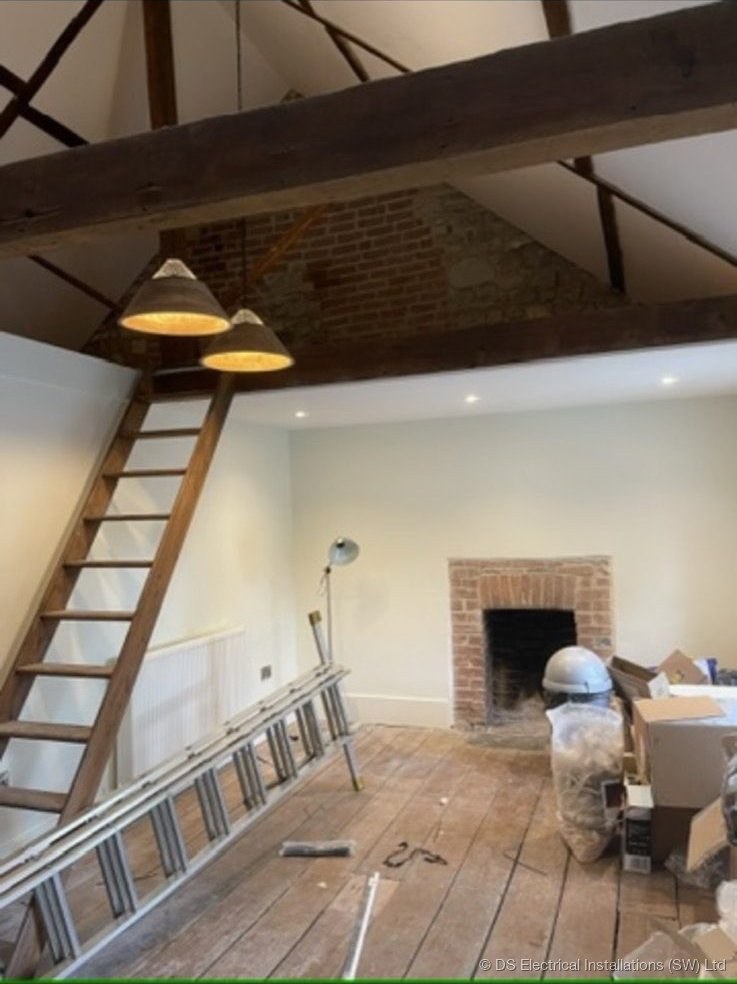
- No surface trunking on stone walls. All cabling concealed in service voids in the cathedral ceilings, plasterboard-on-batten stud walls, joist drillings under the engineered-oak floors, and chased channels in plasterboard partitions only. Where stone penetrations were unavoidable, cut sleeves drilled through pre-existing opes and made good with lime mortar.
- Click Scolmore Deco Plus screwless metallic accessories throughout, matt-black plates in the open-plan living, satin-chrome in the bathrooms, white in the utility.
- Trailing-edge dimmer modules on every primary lighting zone so the customer can run any dimmable LED lamp without retro-pickup or buzz.
- BS 7671 inspection-and-test on every circuit, every reading logged. NAPIT-format Electrical Installation Certificate per board, schedule of test results, Part P notified through NAPIT to local building control. ASHP MCS-friendly photo log handed over for the heat-pump installer's MCS application.
- VAT-itemised invoice with VAT @ 20%.
The boards
| Component | Spec |
|---|---|
| Main intake | 100 A single-phase (DNO uplift) |
| Main board | Hager metal-clad RCBO + Type 2 SPD + bedroom AFDD |
| Annexe board | Hager metal-clad RCBO via 16 mm² SWA sub-main |
| Heat-pump circuit | 32 A radial, 6 mm², Type A 30 mA RCBO |
| EV-ready socket | 32 A radial, 6 mm², Commando + sub-meter pre-wire |
| Outdoor sockets | 20 A radial, IP66, Type A 30 mA RCBO |
| Garden lighting | 6 A radial via SWA, Type A 30 mA RCBO |
| Lighting | Trailing-edge dimmer modules throughout |
The result
The customer now has a barn that looks the way they paid for it to look (stone where stone should be, no surface containment cluttering original elevations) and a wiring system future-proofed for the rest of the build-out: heat pump live, EV charger plumbed and ready, garden circuits in for landscaping, dimmable lighting on every primary zone. Two boards keep the annexe usable as an independent space, including the option to short-term let it without sharing electrical control with the main house.
Who it's for
Owners of barn conversions, stone outbuildings, period agricultural conversions and exposed-stone country houses where the wiring needs renewing without scarring the fabric. Also fits new-build family homes that want a multi-board topology with annexe / granny-flat separation, heat pump and EV future-proofing built in from day one.
Why this approach. Barn conversions live or die on the cable strategy. Decide the board topology before first-fix, plumb the heat pump and EV circuits even if the kit is months away, run nothing across exposed stone, and accept that a 12-day rewire is normal, the alternative is a 7-day rewire that has to be redone in 5 years.
Also see: house rewires, EV chargers, Grade II Bath heritage rewire.