
Generic case study. We do not name the building, the address or the owners, the value is the cabling strategy, the metering and the DNO sequence.
The brief
A 1970s detached house in Bath, divided in the 1990s into 2 self-contained flats with separate front doors, separate energy meters but a shared 60 A communal incomer. Two off-street parking bays, one per flat, both on the same gravel driveway. Both households had committed to electric vehicles and wanted their own dedicated 7 kW charger so neither was dependent on the other. The brief: install both chargers and meter each charger separately so EV electricity could be billed clean of the household supply if either flat went on the rental market.
What we did
- Site survey + load assessment. Existing 60 A communal incomer measured under load. Two 32 A EV circuits would have pushed the supply over its rated capacity, an upgrade was non-negotiable.
- DNO notification submitted for the 60 A to 100 A upgrade. DNO attended within their booked window to upgrade the cut-out and tails.
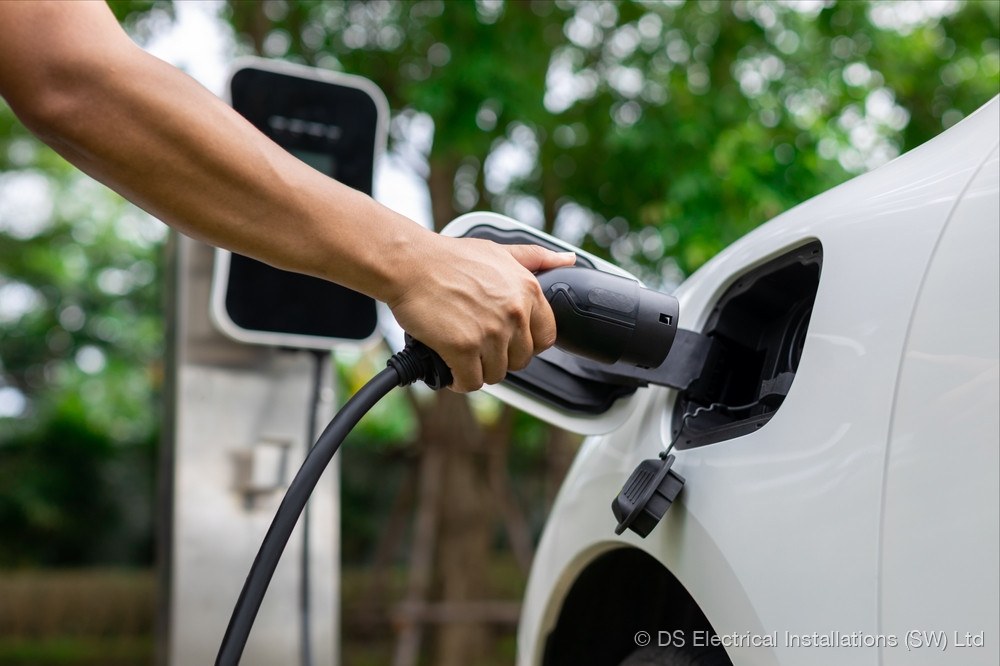
- Two Hypervolt Home 3 Pro 7 kW chargers installed, one per flat, mounted on the boundary wall above each bay with the cable tail running clear of the gravel.
- Type A 30 mA RCBO with DC fault detection on each charger circuit. EV chargers always go on Type A, never Type B, per BS 7671 and EVSE manufacturer guidance. Type B is for specific industrial DC scenarios, not domestic EV charging.
- MID-approved kWh sub-meter on each charger feed so each flat's EV usage is metered independently of the household.
- BS 7671 inspection-and-test on both circuits, EVSE function test, NAPIT-format Electrical Installation Certificate per circuit, Part P notified through NAPIT to local building control.
The board, per flat
| Component | Spec |
|---|---|
| Charger | Hypervolt Home 3 Pro 7 kW |
| Circuit | 32 A radial, 6 mm² T+E + SWA garden run |
| Protection | Type A 30 mA RCBO with DC fault detection |
| Sub-meter | MID-approved kWh sub-meter, sealed |
| PEN-fault | Built-in PEN-loss device (no earth rod) |
| Communal incomer | 100 A switched isolator (DNO upgrade) |
The result
Both flats now charge independently, each at full 7 kW, with no risk of tripping the communal incomer. Each flat owns its EV electricity bill. The shared mains is now future-proofed at 100 A, leaving headroom for a possible heat-pump retrofit on either flat without going back to the DNO.
Who it's for
Owners or landlords of multi-flat conversions, terraced rentals, HMOs or coach-house conversions where one supply feeds 2 or more dwellings and at least one occupant wants an EV charger. The pattern travels: separate sub-meter per charger so the bill is clean, DNO uplift where the existing incomer can't carry the load.
Why this approach. Most flat conversions assume the EV charger is a "one charger, share the cable" problem. It isn't. With separate metering and a properly sized communal incomer, every flat gets a real, full-rate, independently-billed charger.
Also see: EV chargers, commercial EV fleet case study.