
Generic case study. We do not name the property, the address or the owner, the value is the lighting design, the routing strategy and the dimming circuit topology that lets a 21st-century cinema feel sit inside a Georgian drawing room without harming it.
The brief
A Somerset listed Georgian townhouse, principal first-floor drawing room (5.4 m × 6.8 m, 3.4 m ceiling, original lath-and-plaster, full-height working sash windows, original ceiling rose, deep moulded cornice on all four walls). The owners wanted “cinema-feel” lighting for evening entertaining and film nights without losing the daytime drawing-room character. Existing lighting was a single pendant on the ceiling rose and one wall sconce, flat, bright, undimmable. Brief was: low-level cove-strip uplight to wash the cornice, a tight grid of dimmable downlights on the seating area for film nights, brass plate switches throughout, and absolutely no surface trunking, no chasing into the cornice, no replastered ceiling.
Conservation-area constraints
Bath is a UNESCO World Heritage Site and the property sits inside the Bath Conservation Area as well as being individually Grade-II listed. Internal alterations to a Grade-II property can need listed-building consent depending on what's being touched. We assumed it might.
- Pre-work liaison with the B&NES conservation officer with a written method statement and reversibility note
- Original ceiling rose, cornice and architrave photographed before any work began, stored with the job file
- Agreed cable routes (floor void above, behind the cornice rebate, never through the cornice itself)
- Dust sheets, MDF boarding over the original parquet, no skip outside the front elevation
What we did
Cinema downlight grid
- 12 × LED dimmable downlights arranged in a 3 × 4 grid over the seating area, drilled through the floorboards above (which lift cleanly), not the lath-and-plaster ceiling below
- Fire-rated, IP65, 2700 K warm white, CRI >90 for accurate skin-tone in film and TV
- Beam angle 38° for a tight seating-area pool that doesn't bleach the cornice
Concealed cove-strip uplight
- Continuous 24 V LED tape (2700 K, 24 W/m, dim-to-warm) recessed into a slim aluminium channel sat on top of the existing cornice rebate
- Channel and tape entirely invisible from the floor, uplight washes the cornice and ceiling, brings the original plaster work to life
- 24 V driver located in the floor void above, accessible from a lifted board, never inside the room
Three dimming zones
- Zone 1, downlights only (film mode: low, warm)
- Zone 2, cove strip only (ambient mode: cornice glow, room dark)
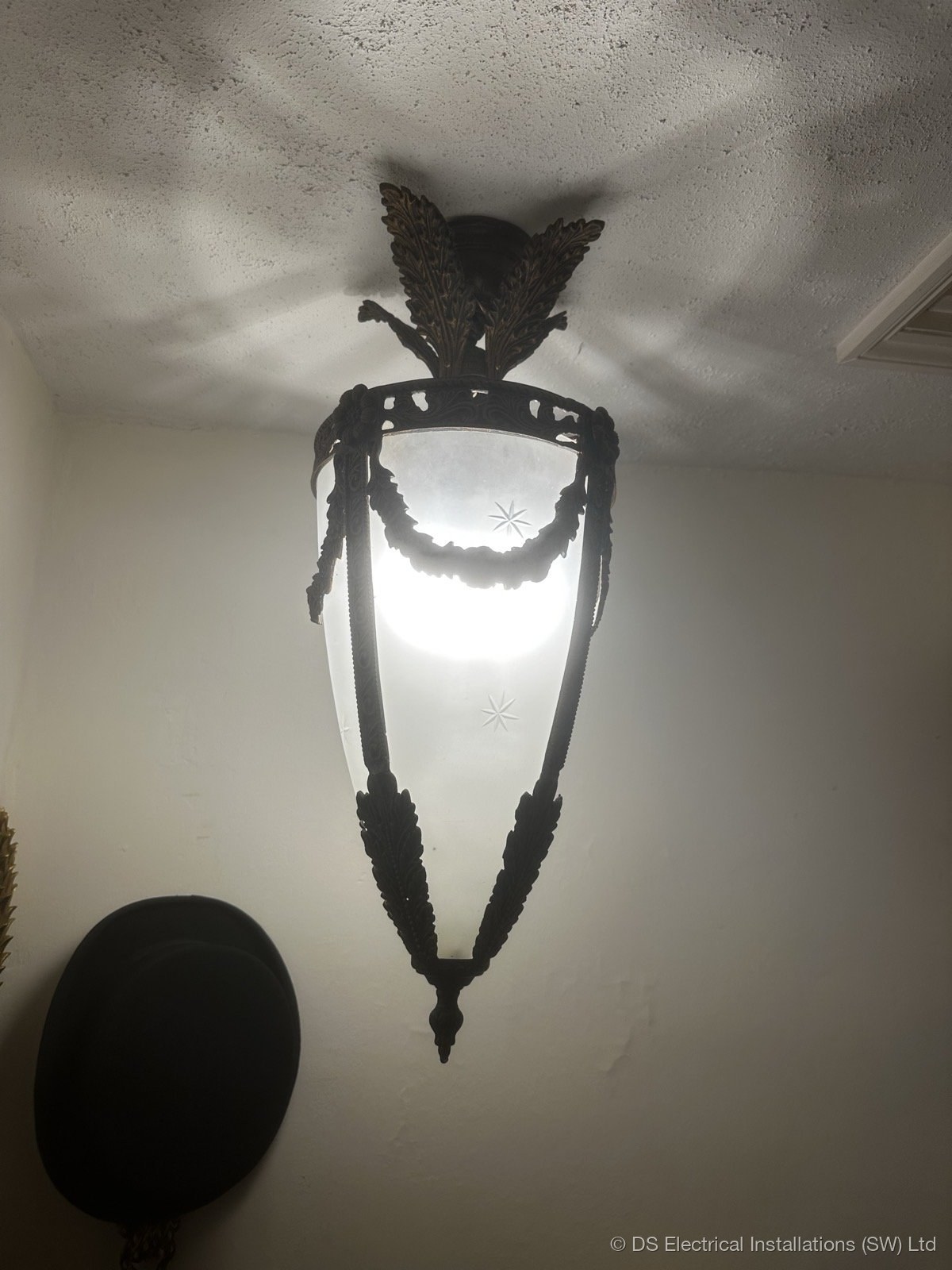
- Zone 3, pendant + sconce (drawing-room mode: traditional)
- Switchable in any combination from a single brass 3-gang plate at the door, with bedside-style 1-gang plates near the seating
Brass plate fittings, no surface trunking
- Antique-brass dolly switches and dimmer plates throughout (period-correct, not modern chrome)
- All cabling pulled through the floor void from the room above, original ceiling untouched
- Switch drops behind original skirting where it lifts cleanly; no chasing into the original lath-and-plaster walls
- Driver and dimmer module in the joist void above with maintenance access via a lifted board
The kit
| Component | Spec |
|---|---|
| Downlights | 12 × LED, IP65, fire-rated, 2700 K, CRI >90, 38° beam, dimmable |
| Cove strip | Continuous 24 V LED tape, 2700 K, 24 W/m, dim-to-warm |
| Drivers | Mains-dimmable 24 V LED drivers, located in floor void above |
| Switching | Antique-brass dolly switches, 3-gang at door, 1-gang at seating area |
| Cable | 3-core flex on lighting circuits, all routed through floor void above |
| Protection | Lighting circuit on Type A 30 mA RCBO, dedicated 6 A MCB at the board |
| Standards | BS 7671 (18th Edition Amd 2), Part P notified via NAPIT |
Six working days, room used throughout
- Day 1, Survey, marking out, conservation sign-off. Floor lifted in the room above, void surveyed, downlight grid marked on the ceiling from below using a laser level and pencil dots on masking tape (never on the original plaster).
- Day 2, First fix. Downlight cores drilled through floorboards from above, cove channel test-fitted, cable runs pulled to the new switch positions.
- Day 3, Driver location, dimmer wiring. 24 V drivers installed in the floor void with maintenance access. Dimmer modules wired and labelled.
- Day 4, Second fix. Downlights set, cove tape installed in channel, brass plates fitted.
- Day 5, Test & commission. Each zone tested independently, dim-to-warm verified through full range, BS 7671 inspection-and-test on the lighting circuit.
- Day 6, Handover. Walk-through with the owner, all three modes demonstrated, paperwork issued.
Result
Three lighting moods on demand. Downlights only at 8% for a true cinema feel with no glare on the screen. Cove strip alone for ambient evening reading. Pendant plus sconce for daytime drawing-room use. None of it visible during the day, the ceiling reads as the original Georgian plaster with one period rose. Conservation officer signed off the completed work without query. Owner's energy bill on the lighting circuit dropped roughly 60% versus the old halogen sconce-and-pendant setup the room previously had. No callbacks since handover.
Why this approach. A heritage drawing room can absolutely have cinema lighting. The trick is doing it from the room above, not from inside the room itself. Drill cores through floorboards, run cable through the joist void, hide the drivers in maintenance access, leave the original ceiling, cornice and plaster untouched. The room ends up with both centuries living in it, quietly.
Who it's for
Owners of Grade-II listed Georgian or Victorian properties in Bath, Wells, Frome, Shepton Mallet or surrounding listed-village locations who want modern lighting design without losing the period character or the listed-building consent. Typical projects: drawing rooms, dining rooms, principal bedrooms, snugs, libraries. We handle the conservation-officer liaison and the method statement so you don't have to.
BS 7671 cert + Part P
Handover paperwork:
- BS 7671 Minor Works / Electrical Installation Certificate, NAPIT-format, lighting-circuit readings logged
- Part P Building Regulations Compliance Certificate, notified through NAPIT to local building control
- Method statement and reversibility note filed with the customer for any future listed-building application
- Photographs of every original feature before, during and after
- VAT invoice, itemised, VAT @ 20%
Also see: heritage installations, heritage Bath, lighting design.