
Generic case study. We do not name the operator, the homes or the residents, the value is the testing approach, the cross-check with fire and emergency-lighting compliance, and the CQC-friendly pack we hand over after each visit.
The brief
A care-home operator with four sites across the South West (mix of converted Victorian residential, purpose-built single-storey, and one 1970s extended block). All four properties were due for periodic EICR. The previous contractor had delivered a one-page certificate per site with no schedule of test results, no photos, no observations log, and the registered manager was being asked by CQC inspectors during a routine visit to evidence electrical safety. The brief: a proper rolling cycle, per-site, BS 7671 Amd 2, with a compliance pack the manager could hand to a CQC inspector without flinching.
What we did
Survey + planning, all four sites in a single afternoon
- Walked every distribution board (DB), main switch panel, and meter cabinet across all four sites in one afternoon
- Counted final circuits per property (range: 28-46), identified the supply type (all 3-phase TP&N), and noted any restrictions (resident-occupied rooms, kitchens during meal service, medication rooms)
- Agreed with the registered manager which days/times each property could lose power on which boards (early morning before resident wake-up, mid-afternoon outside meal windows)
- Issued a written programme: 4 sites × 1-2 days each, rolled across two weeks
3-phase BS 7671 Amd 2 inspection & testing
Each site tested to BS 7671 Amendment 2 (the current 18th Edition update), full periodic, with all readings logged per circuit:
- Insulation resistance, live conductors to earth, every final circuit, recorded in MΩ
- Continuity of CPCs and bonding conductors, every circuit
- Polarity verified at every accessory
- Earth fault loop impedance (Zs) on every circuit, compared to maximum permitted for the protective device
- RCD testing, trip times at IΔn and 5×IΔn, every protective device
- Visual inspection against BS 7671 Chapter 64, with thermal imaging on board terminations and 3-phase main switches under load
BS 5839-1 fire-alarm cross-check
Care homes are life-safety premises. We treat the fire alarm as inseparable from the EICR.
- Logged the fire-alarm panel make, model, last-service date, last-test-log entry and any standing faults, cross-referenced against the on-site BS 5839-1 service log
- Verified the fire-alarm circuit was on a dedicated, labelled MCB at the board (not RCD-protected, per BS 5839-1)
- Flagged any fire-alarm finding that needed the appointed BS 5839-1 contractor (we don't service fire alarms; we cross-check that they exist, work, and are documented)
BS 5266 emergency-lighting cross-check
- Walked every escape route at low level with the mains off, verifying every emergency luminaire illuminated and gave the required minimum lux
- Logged the make/model of each emergency luminaire, last 3-hour discharge test result from the on-site BS 5266 log
- Flagged any battery showing premature discharge, any luminaire with no test record, any escape route with insufficient coverage
The kit (test gear)
| Tool | Spec |
|---|---|
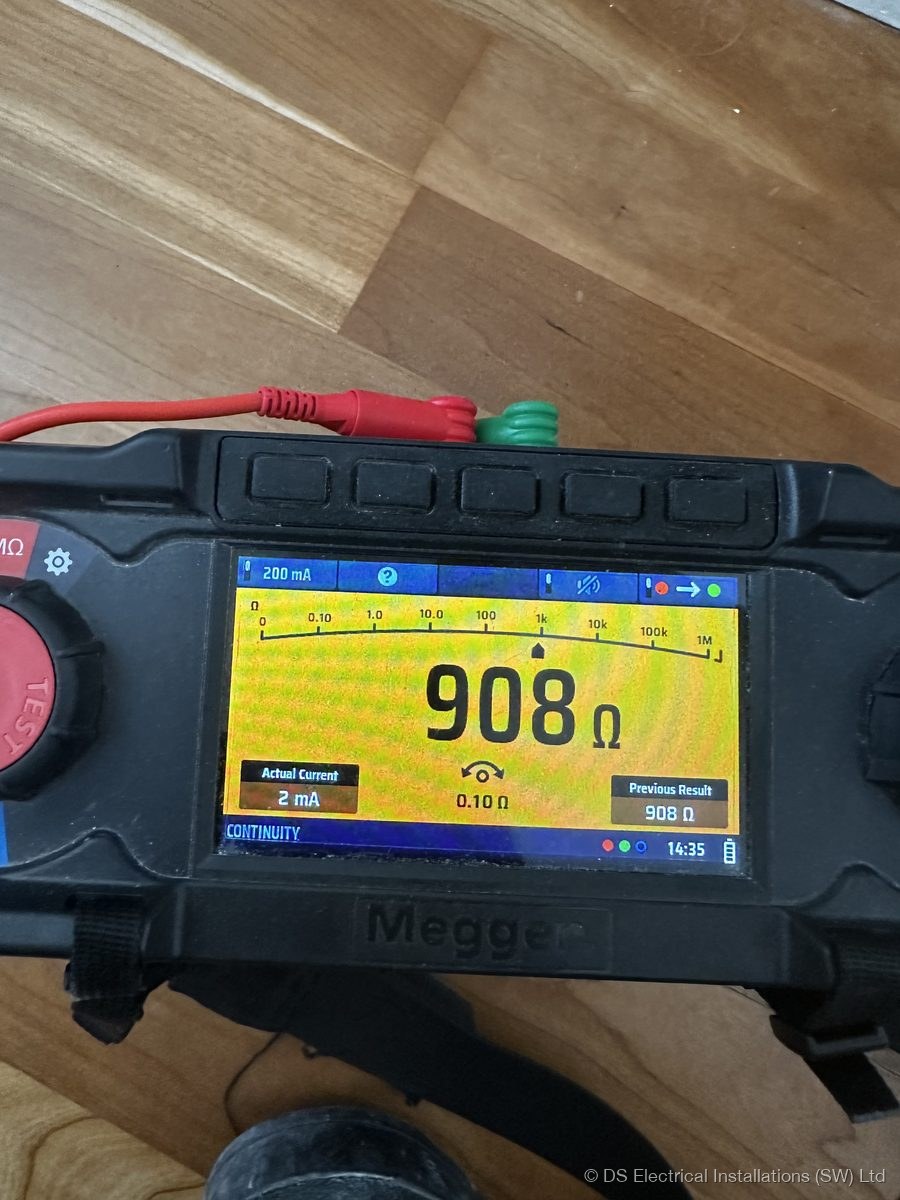
| Multifunction tester | Megger MFT, calibrated, certificate on file |
| Insulation | 500 V test, >1 MΩ minimum, recorded per circuit |
| Earth fault loop | Zs measured at end of every final circuit |
| RCD trip time | IΔn and 5×IΔn on every device |
| Voltage indicators | Fluke 2-pole approved voltage indicators (proved before/after every isolation) |
| Thermal imaging | Hand-held thermal camera on TP&N main switches and DB terminations under load |
| Cert format | NAPIT-format EICR + full schedule of test results, per property |
CQC-friendly compliance pack, per property
Each property gets its own folder, paper and digital, handed to the registered manager:
- EICR cover sheet, satisfactory / unsatisfactory, signed and dated
- Schedule of test results, every final circuit, every reading
- Schedule of inspections, every Chapter 64 item, ticked or commented
- Observations log, C1 / C2 / C3 / FI codes with photos and explanations a non-electrician can read
- BS 5839-1 fire-alarm cross-check note, status of the panel and any flag for the fire-alarm contractor
- BS 5266 emergency-lighting cross-check note, per-luminaire status
- Thermal-imaging photos of main switches and DB terminations under load
- Recommended remedial works list with per-item indicative pricing
- Re-test date on the front of the folder, set per BS 7671 guidance for the property type
Per-property indicative pricing
- From £800, smaller property, ~28 final circuits, single 3-phase board
- From £1,000-£1,200, larger / multi-board property, ~46 final circuits, kitchen DB and resident-wing DB to test independently
- All prices subject to VAT @ 20%
Result
Two of the four sites came back fully Satisfactory at first test. Two had C2 observations (a bonding to the gas service that had been disconnected during a boiler swap, an outdated metal-clad board with no surge protection on the resident-wing supply). Both C2s remediated within two weeks of the EICR visit, re-tested and uplifted to Satisfactory. Operator now holds a full per-property compliance pack ready for any unannounced CQC visit. Annual cycle agreed for renewal of the two larger sites, biennial for the two smaller (per BS 7671 risk-based intervals).
Who it's for
Care-home and supported-living operators, retirement-village managers, NHS-contracted residential providers, dementia-care and nursing-home groups across Mid Somerset and surrounding areas, Bath, North Somerset and Wiltshire. Particularly suited to operators who need a single contractor to handle the full estate, deliver consistent paperwork format across sites, and cross-check fire and emergency-lighting compliance alongside the electrical EICR.
Why this approach. A care-home EICR is a CQC artifact, not just an electrical certificate. The registered manager needs to put it in front of an inspector and have every reading, every observation, every photograph make sense to a non-electrician. We write the paperwork like the inspector is going to read it, because they are.
Also see: EICR, commercial electrical, care home electrician.