
If you rent out a property in England, you are legally required to hold a valid Electrical Installation Condition Report (EICR). The rules have applied to all tenancies since April 2021, and with councils increasingly enforcing them, the question is no longer whether you need one, it is whether yours is still in date and what happens if it fails.
This guide covers exactly what the law requires, what the certificate codes mean, and the five defects our engineers find most often in rental properties across Wells, Bath, Shepton Mallet, and the surrounding Somerset area.
What the Electrical Safety Standards 2020 Actually Require
The Legislation at a Glance
The Electrical Safety Standards in the Private Rented Sector and Social Rented Sector (England) Regulations 2020 apply to private and social rented tenancies, including licences to occupy, in England.
Under the 2020 Regulations, landlords in England must:
- Carry out an EICR at least every five years, or more frequently if the report itself specifies a shorter interval.
- Use a qualified and competent person to carry out the inspection. In practice this means someone registered with a competent person scheme such as NAPIT or NICEIC, or a qualified electrician who can demonstrate equivalent competence.
- Give a copy of the current EICR to existing tenants within 28 days of the inspection being completed.
- Give a copy to a new or prospective tenant before they move in, or before they enter the tenancy agreement, whichever is earlier.
- Provide a copy to the local housing authority within 7 days of receiving a written request, councils are entitled to ask, and some do.
- Carry out any remedial or further investigative work within 28 days of the inspection date (or within any shorter period specified in the report for urgent works). Then give the tenant and the council written confirmation, with the report, within 28 days of finishing the work. If the report says a fault is immediately dangerous, 28 days is the ceiling, not the target.
- Retain written confirmation from the electrician that all remedial work has been carried out, and supply it to the tenant and (if requested) to the council.
Non-compliance is a civil matter dealt with by local housing authorities. Councils can issue a remedial notice and, if it is ignored, carry out the works themselves and recover the cost from the landlord. Financial penalties for breaches can reach £40,000 per breach.
What the EICR Codes Mean
Every item on an EICR is classified with one of four codes. Understanding what they mean is crucial, because the remedial obligation (and the timeline) depends entirely on which codes appear on your report.
| Code | Meaning | Action Required |
|---|---|---|
| C1 | Danger present. Risk of injury, immediate action required. | Immediate. The report period cannot begin until this is remedied. Tenants must be informed. |
| C2 | Potentially dangerous. Urgent remedial action required. | Within 28 days (or the period stated in the report, can be shorter). |
| C3 | Improvement recommended. No legal obligation to act. | No mandatory action, but worth addressing, good landlords do. |
| FI | Further investigation advised. Inspector could not fully assess it within the agreed limits. | Does not on its own make an A4 report unsatisfactory, but landlords must get any further investigation the report requires done within 28 days. |
An EICR that contains any C1 or C2 codes is classified as Unsatisfactory, meaning the installation has not passed. An Unsatisfactory report is still a valid document for compliance purposes, provided you act on the codes within the required time and obtain written sign-off.
A report containing only C3 observations is classified as Satisfactory, even though improvements are noted.
Need an EICR for a rental property?
Firm quote in 24 hours, same-day certificate once tested. We cover Wells, Bath, Shepton Mallet, Frome, and all of Somerset.
The 5 Most Common EICR Failures We See in Rental Properties
After carrying out hundreds of EICRs across Mid Somerset and surrounding areas, the same defects come up repeatedly. None of them are catastrophic, but all of them will generate a C1 or C2 code and trigger the remedial obligation. Here is what to watch for before you book your inspection.
Fail 1: No RCD Protection on Socket Outlets
This is the single most common C2 we issue. Regulation 411.3.3 of BS 7671:2018 requires RCD protection for all socket outlets rated up to 32A that may be used by ordinary persons, which in a rental property means virtually every socket in the house.
Older properties, particularly those built before 2008, frequently have consumer units with a single RCD protecting half the circuits, leaving other circuits (including socket circuits) unprotected. Some very old boards have no RCD at all.
The fix is a consumer unit upgrade to a modern full-RCBO board. For a property already generating a C2 on this ground, addressing the board at the same time as the EICR makes sense, we can carry out both visits on the same day.
Fail 2: Old Fusebox with Rewireable Fuses
A fusebox with ceramic or porcelain rewireable fuse carriers is a near-automatic C2. These boards, common in properties built before the mid-1990s, have no RCD protection, no earth leakage detection, and typically no main isolating switch that meets modern standards.
Beyond the RCD issue, rewireable fuses can be over-fused: a tenant (or a previous owner) can replace a 5A fuse with a 30A one, removing the overcurrent protection entirely and creating a serious fire risk. Modern circuit breakers make that impossible.
If you are purchasing a rental property and the surveyor flags an old fusebox, budget for a replacement as part of your acquisition costs. It will come up in the EICR.
Fail 3: Missing or Inadequate Earth Bonding on Gas and Water Pipes
Main protective bonding, the 10mm² green/yellow cable connecting the incoming gas and water services to the consumer unit earth terminal, is required by Regulation 411.3.1.2 of BS 7671. It prevents metallic pipework from becoming live if a fault occurs anywhere on the electrical installation.
In our experience, roughly one in four older rental properties either has no main bonding at all, or has bonding cables that are undersized (6mm² instead of 10mm²), in poor condition, or connected to the wrong point on the pipework. This is a C2 every time, and sometimes a C1 if there is active risk of contact with live metalwork.
The remedial work is straightforward, a few hours for a qualified electrician, but it must be done before the report can be closed out as Satisfactory.
Fail 4: Damaged Sockets or Switches with Exposed Terminals
A cracked socket faceplate, a socket that has been pulled partly out of the wall, or a switch with a missing or broken cover, these are all C1 or C2 items depending on whether live terminals are accessible.
In furnished rental properties, damage accumulates over tenancies: sockets get knocked by furniture, plug-in air fresheners crack faceplates, and the sort of damage that a homeowner would fix immediately can linger in a rental. A pre-EICR walkthrough to replace visibly damaged accessories is 30 minutes of work that prevents a C1 on your report.
Don't Wait for the EICR to Spot Obvious Damage
If you can see a cracked socket, a scorch mark near a switch, or a socket hanging off the wall during a routine inspection, address it immediately, your duty of care as a landlord does not wait for a five-yearly inspection cycle. The EICR is a minimum baseline, not a complete substitute for regular visual checks.
Fail 5: Outdoor Sockets Without Adequate IP Rating
Outdoor socket outlets, on the external wall of the house, in the garden, in a garage, or in an outbuilding, must be rated to at least IP44 (splash-proof) and must have RCD protection. Many properties have outdoor sockets that were added years ago without a weatherproof cover, using an indoor-rated socket in a surface-mounted box that offers no water ingress protection.
This generates a C2 and, if the socket is visibly damaged or water has entered the back box, potentially a C1. The fix, replacing with a correctly rated outdoor socket and verifying RCD protection, is usually a half-hour job. Garden offices and outbuildings with sub-mains fed from the main property are increasingly common and are a frequent source of FI codes where the sub-main installation cannot be fully verified.
What Happens If My EICR Is Unsatisfactory?
An Unsatisfactory EICR is not a disaster, it is a list of jobs. The 28-day clock starts from the date of the inspection (or a shorter period if the report says so). Here is the process:
- Receive the EICR, the inspector will walk you through the codes before you leave (we always do this).
- Book the remedial work, ideally with the same contractor who carried out the EICR, so they know exactly what needs doing and can sign off without a second visit charge.
- Remedial work completed and verified, the electrician issues written confirmation that all C1 and C2 items have been addressed.
- Provide the documentation, written confirmation of the completed work and the report, to the tenant and the council within 28 days of finishing the work.
We include remedial sign-off at no extra charge when we carry out the EICR and the follow-up work. For landlords with multiple properties, we can schedule EICRs and remedials as a single visit where the defects are known in advance.
How Much Does a Landlord EICR Cost in 2026?
Our landlord EICR is priced on the size of the installation and the number of circuits, not a flat fee, and commercial 3-phase installations are quoted the same way. We confirm a fixed price before we start. Portfolio discounts for multi-property landlords. Certificate issued the day of testing.
Why we price by circuit, and what a proper EICR involves
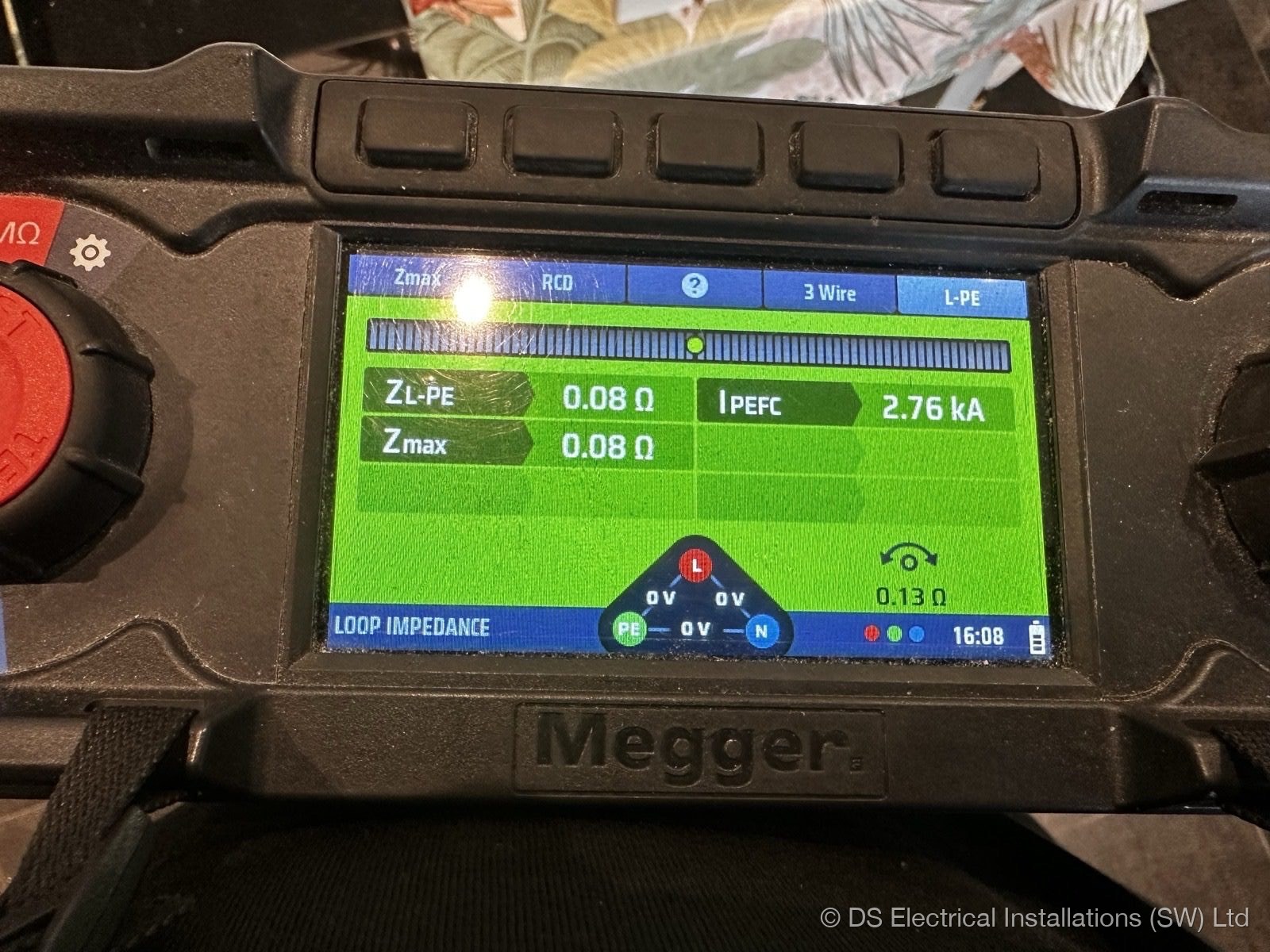
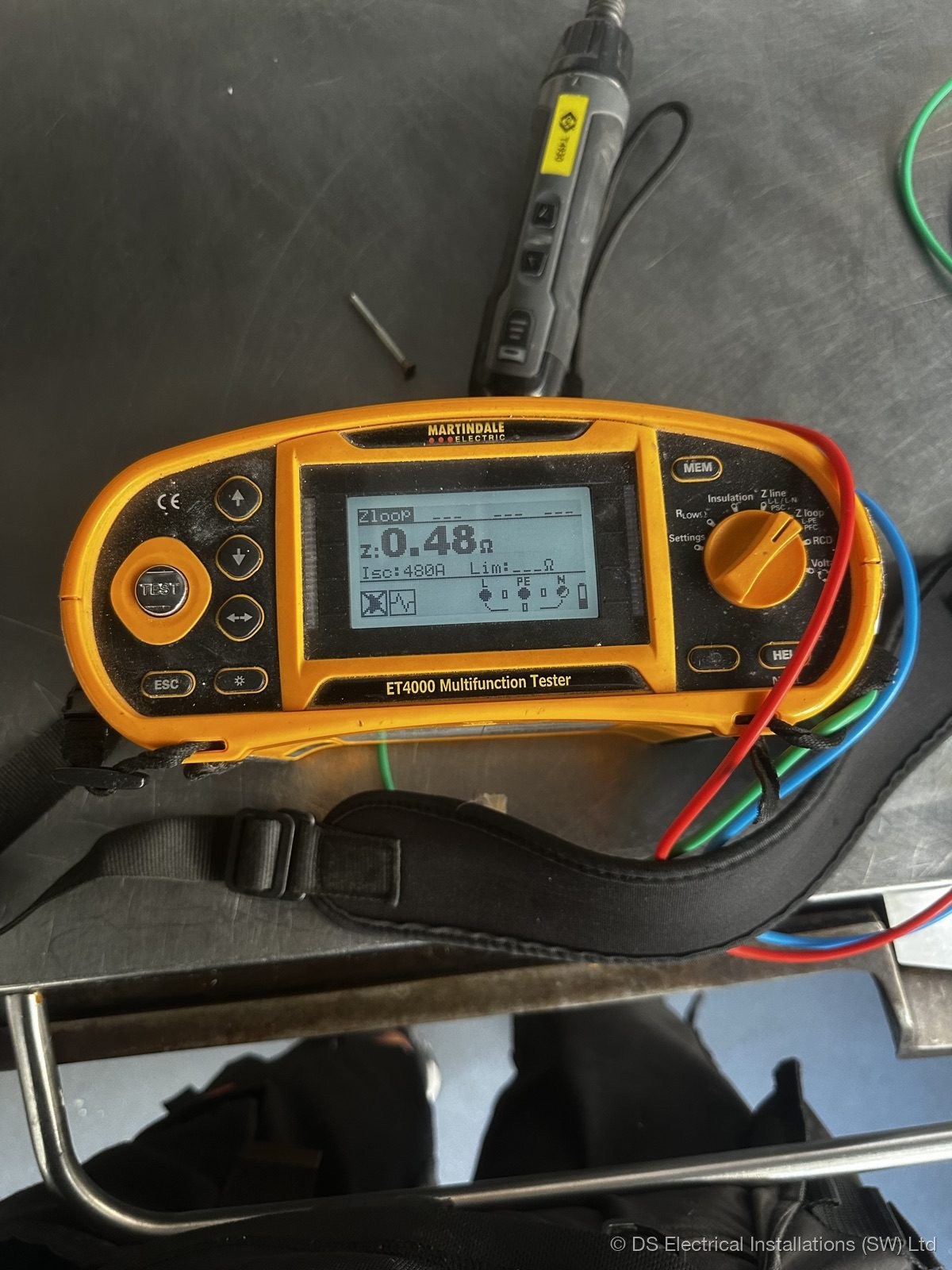
Not every EICR advertised online is a statutory-compliant inspection. A proper EICR is an in-depth testing procedure that every circuit goes through, dead and live: insulation resistance at 500V DC, earth-loop impedance measured against short-circuit fault current, RCD trip-time at the rated residual current (1×IΔn), continuity end-to-end (R1+R2), polarity, bonding, earthing. Every result recorded against BS 7671 criteria.
That testing requires calibrated specialist kit, a Megger MFT1741 multifunction tester, which must be re-certified annually with a UKAS-traceable calibration certificate. An out-of-calibration tester invalidates every reading on the report. The inspector holds the City & Guilds 2391/2394/2395 Level 3 Award in Inspection, Testing & Certification, also holds City & Guilds 2382 (18th Edition), works to BS 7671:2018+A4:2026, and has an annual subscription to NAPIT (66245), so landlords can check our competence independently. Plus £2M public liability cover, continuing professional development, vehicle and consumables.
Per-circuit pricing is the fairest way to reflect that work. A flat rate either undercharges on large houses or overcharges on small flats. Pricing by circuit count means the quote matches the actual installation, and the certificate is worth something when you show it to a lender, an insurer, or the local authority.
If remedial work is needed, we will quote separately before starting, no surprises. Common remedial jobs (replacing a damaged socket, adding a bonding cable, fitting a weatherproof outdoor socket) are priced per task.
Landlords who want to see what our customers across Mid Somerset and surrounding areas say about our work can read reviews on the testimonials page.
How Often Do You Need an EICR as a Landlord?
The legal maximum is every five years. In practice, the interval written on the EICR certificate may be shorter: an inspector can specify three years if the installation has age-related concerns that do not rise to a C2, or if there are FI items that were resolved but that warrant earlier re-inspection. Always check the "next inspection due" date on your certificate, not just the date it was issued.
A new EICR is also required when a new tenancy begins if the existing certificate has expired, or if a significant alteration or addition has been made to the electrical installation, even if the certificate is still in date. Fitting a new kitchen, for example, typically constitutes a material alteration.
Common questions
Are landlords legally required to have an EICR?
Yes. Since April 2021, all private landlords in England must have a valid EICR for every rental property; since November 2025 the same regulations also cover housing associations and council landlords. The EICR must be no more than 5 years old, supplied to tenants within 28 days of inspection, and any C1/C2 faults remediated within 28 days. Failure to comply risks penalties of up to £40,000 per breach.
What happens if a landlord EICR comes back unsatisfactory?
If the EICR is Unsatisfactory (C1 or C2 codes present), you have 28 days to remediate the faults (or less if urgent). You must provide the tenant with a copy of the EICR within 28 days of the inspection. Once remedial work is complete, a satisfactory completion certificate is issued. We quote for remedials immediately after the EICR.
How much does a landlord EICR cost in Somerset?
The price depends on the size of the installation and the number of circuits. We confirm a fixed price before we start. We offer portfolio rates for letting agents and landlords with 5+ properties. Same-day certificate for satisfactory installations.
Can a tenant request an EICR copy?
Yes — landlords must provide a copy of the EICR to existing tenants within 28 days of the inspection, to new tenants before they move in, and to prospective tenants within 28 days of a written request. Failing to provide copies is a breach of the Regulations; the council can impose a financial penalty of up to £40,000.