
Most commercial premises in the UK start life on a single-phase supply, the same 230V system that powers homes. For a small office or retail unit, that’s perfectly adequate. But as businesses grow and add machinery, EV charging points, catering equipment, or server infrastructure, single-phase can become a hard ceiling on what your premises can safely do. This guide explains the difference between single and three-phase power in plain English, when an upgrade becomes genuinely necessary, and what the process involves from initial survey through to DNO connection.
Quick answer: If your business regularly draws more than 20kW of continuous load, runs three-phase machinery, or is installing multiple rapid EV chargers, you almost certainly need a three-phase supply. Allow 4-12 weeks from application to energisation, and get a site visit booked early so the DNO application can go in.
Single-phase vs three-phase: what’s the difference?
Single-phase power delivers electricity via one live conductor (plus neutral and earth). In practice you get 230V at the socket, with a maximum safe continuous draw of around 80-100A on a standard commercial cut-out, roughly 18-23kW before losses.
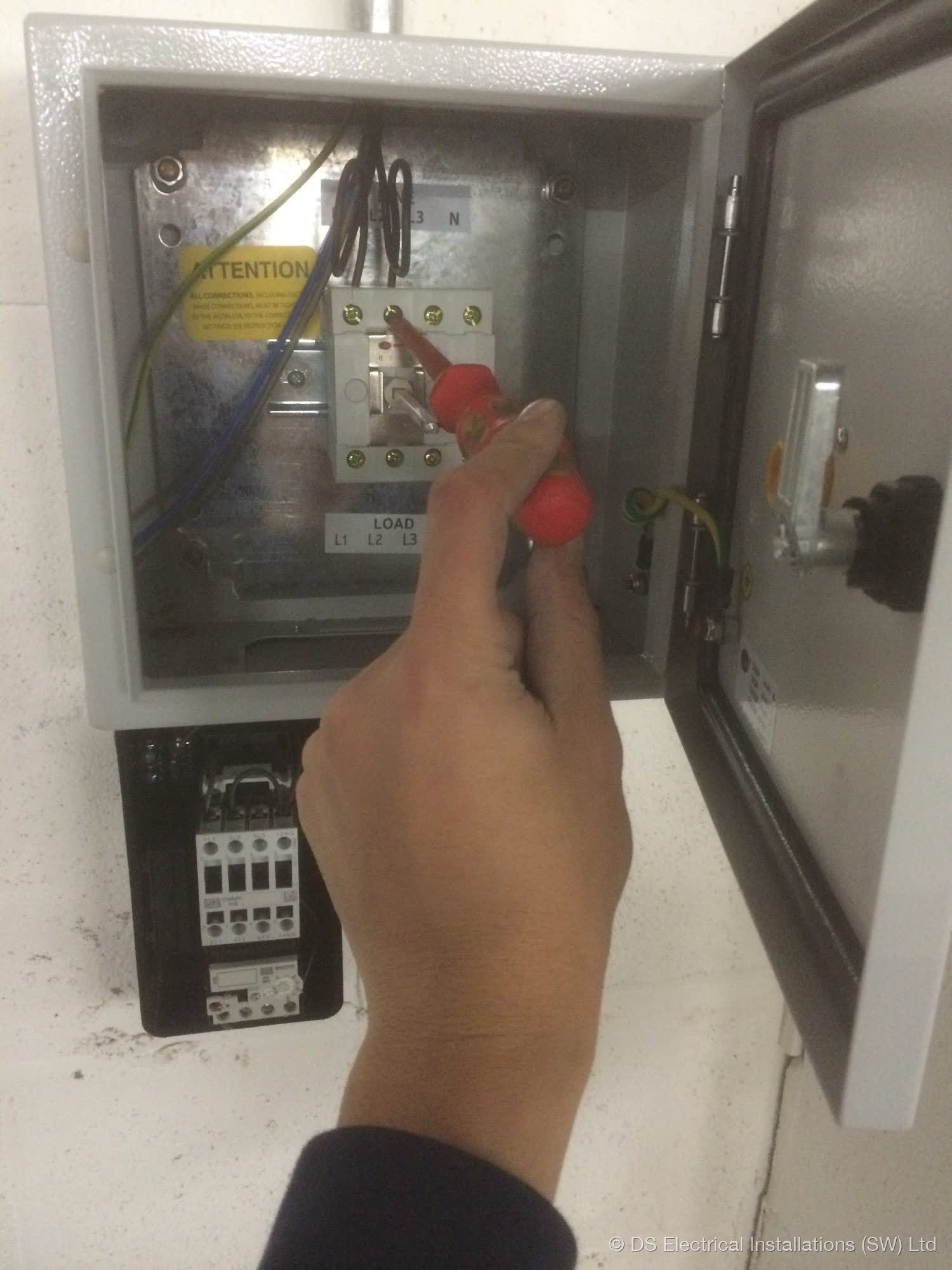
Three-phase power delivers electricity via three live conductors, each 120° out of phase with the others. The voltage between any phase and neutral is still 230V, but the voltage measured between two phases is 400V. The practical result is that a three-phase installation can carry three times the current through three separate paths, giving you up to 69kW+ of usable capacity on a 100A three-phase cut-out, without pushing dangerous current through any single wire.
Three-phase also makes large motors, compressors, and variable-speed drives far more efficient. A single-phase motor above about 2kW requires a capacitor start circuit to create artificial phase shift; a three-phase motor starts and runs smoothly without one, runs cooler, and lasts longer.
When does a business actually need three-phase?
The short answer is: when your single-phase supply can no longer safely carry your peak load without overheating, tripping, or causing voltage dips that affect other equipment. More specifically, upgrade conversations become necessary when:
Continuous load exceeds 20kW
A typical 100A single-phase fuse gives you a theoretical maximum of 23kW, but you should never run a supply at more than 80% of rated capacity continuously. That puts a safe ceiling at around 18-19kW. A busy commercial kitchen, a small manufacturing unit, or a workshop with several large machines will exceed this quickly. With three phases you can distribute load across all three conductors, each carrying its own share.
Three-phase machinery is involved
Industrial lathes, CNC machines, large compressors, commercial refrigeration, woodworking machinery, laser cutters, and most heavy-duty motors above 2kW are designed for three-phase operation. Running them on single-phase either isn’t possible, requires costly phase converters (which introduce losses and noise), or involves oversized motors to compensate.
Multiple large EV chargers
A single 7kW AC charger can run on single-phase. Two or three simultaneously will strain most single-phase supplies. Rapid 22kW chargers require three-phase as a matter of design. Businesses in Wells, Bath, Frome, or Shepton Mallet running a small vehicle fleet increasingly need three-phase specifically to support on-site charging infrastructure.
Server rooms and data centres
UPS systems above 6-10kVA are available in three-phase input/output models. For server rooms with high-density cooling (CRAC units) and multiple UPS, three-phase distribution ensures balanced loading and gives you greater resilience through phase diversity.
Warning signs your single-phase supply is at its limit
You may not know you’ve outgrown your supply until the symptoms become hard to ignore:
- Main breaker trips under heavy load, especially when large motors start or multiple pieces of equipment come on simultaneously. The inrush current of a motor starting can be 6-8× its running current, tipping an already-loaded supply over the edge.
- Lights dim when machinery kicks in, voltage sag caused by excessive current draw on the supply. It’s a reliable indicator the supply impedance is too high for the load you’re imposing.
- Voltage measured below 216V under load, nominal UK voltage is 230V ±10%, so 207V is the minimum acceptable. Below this, motors run hot, electronics behave unpredictably, and you may be voiding equipment warranties.
- Your distribution board is full, if you can’t add circuits without removing others, and you’re already at the maximum single-phase current, a three-phase supply allows a larger main board with significantly more circuit capacity.
- High electricity bills relative to consumption, single-phase motors running inefficiently or at reduced voltage draw more current for the same mechanical output, which shows up in your bills.
The DNO application process
Your electricity supply comes to your premises via the Distribution Network Operator (DNO), for most businesses in Somerset and the surrounding area, that’s National Grid Electricity Distribution (formerly Western Power Distribution). The DNO owns the cables up to your service head; everything on your side is your responsibility.
A three-phase upgrade typically involves two separate scopes of work:
- DNO-side work: Running a three-phase cable from the nearest suitable point on the network to your premises. This is applied for and completed by the DNO (or an Independent Connection Provider working under their licence). You apply directly to NGED, who assess the network capacity and provide a quotation for the connection upgrade.
- Customer-side work: Replacing your main cut-out, meter tails, metering equipment, and main distribution board to accept and distribute three-phase supply. This is carried out by a qualified electrician (us) and requires notification to Building Control under Part P, plus a BS 7671 compliant installation certificate.
Typical timeline
| Stage | Who does it | Typical time |
|---|---|---|
| Site survey & load assessment | DS Electrical | 1-2 days |
| DNO application submitted | You / DS Electrical on your behalf | Week 1 |
| DNO feasibility & quotation | NGED | 2-4 weeks |
| Acceptance & payment to DNO | You | 1 week |
| DNO civil works & cable run | NGED or ICP | 2-6 weeks |
| Customer-side installation | DS Electrical | 1-3 days |
| Energisation & commissioning | NGED + DS Electrical | 1 day |
Total door-to-door: typically 4-12 weeks, depending on DNO workload and whether civil works are straightforward or require road crossings. We routinely help clients prepare their DNO applications and manage the process end-to-end through our commercial electrical service.
What drives the cost of a three-phase upgrade?
Costs vary widely depending on how far the nearest three-phase cable is from your building, how extensive the internal rewire needs to be, and whether the DNO requires road-crossing or significant civils. The work splits into three parts: the DNO connection charge, which NGED quotes for directly; the customer-side board replacement and tails; and any internal rewiring or sub-distribution.
A unit already served by a three-phase network cable just outside the door needs far less work than a rural farm building requiring 150m of underground cable. We provide a detailed breakdown after a site visit so you can see exactly where each cost is going, with our part of the work set out as a fixed written quote.
Worth noting: A three-phase upgrade can often be partially offset against capital allowances if the supply is being upgraded for business purposes. Your accountant can advise, keep all invoices and certificates.
What we cover under a commercial upgrade
A straightforward three-phase upgrade by DS Electrical includes: load assessment and DNO application support, removal of the single-phase cut-out and replacement with a three-phase metering arrangement, installation of a new 3-phase main distribution board rated to your load, all necessary tails and earth bonding to current BS 7671 standards, and a full EICR for the new installation. For premises also needing periodic maintenance going forward, we can bundle the upgrade into a commercial maintenance contract covering annual inspection, emergency lighting checks, and reactive callout.
After the upgrade, you’ll receive a complete certificate pack: the BS 7671 EIC (Electrical Installation Certificate), building control notification, and the DNO completion notice, everything your insurer or landlord may ask for.
Is three-phase always the answer?
Not always. Before recommending a full upgrade, we’ll look at whether load management or load-shifting can solve the immediate problem more cheaply. Sometimes the issue is a single large motor pulling too much current on start-up, which a soft-starter can fix at a fraction of the cost. Sometimes a second single-phase service cut-in from a different DNO phase on the street solves a capacity problem without the complexity of a full three-phase board. We’ll always give you the options honestly, including the ones that cost less.
If you’re in Wells, Bath, Shepton Mallet, Frome, Radstock, Midsomer Norton, Street, Wedmore, Castle Cary, or Bruton, or anywhere in between, and you’re hitting the limits of your current supply, call us for a site assessment. We’ll measure what you’ve got, model what you need, and give you a clear recommendation with fixed prices before any work begins. Read our customer reviews to see how we approach commercial projects.
Common questions
Does my business need a 3-phase electrical supply?
Three-phase is needed when: single appliances draw more than 7kW (commercial ovens, large compressors, industrial motors); you need multiple 32A+ circuits running simultaneously; you are installing a 22kW+ EV charger; or your single-phase supply cannot handle your total load. A load assessment determines whether an upgrade is needed.
How much does a 3-phase supply upgrade cost for a commercial property?
The cost depends on whether the DNO (Distribution Network Operator) needs to upgrade the incoming supply or only the internal installation needs work. DNO works are their cost (separate quote from them). Internal distribution board and wiring is our scope, and we give you a fixed written quote for it after a site visit.
How long does a commercial 3-phase installation take?
Internal 3-phase distribution board installation: 1–3 days depending on size and cable runs. DNO works to upgrade the incoming supply are separately scheduled and can take 4–12 weeks from application. We coordinate the full programme and manage the DNO application on your behalf.
What is the difference between single-phase and three-phase power?
Single-phase power is a 230V, 50Hz supply — standard for domestic and small commercial. Three-phase provides three live conductors at 400V (line-to-line), delivering roughly 3× the power capacity for the same cable size. Three-phase motors and equipment run more smoothly and efficiently than single-phase equivalents.