
Heritage buildings are some of the most rewarding and most demanding projects we work on. Across Somerset – in Bath, Wells, Frome, Shepton Mallet, and the surrounding villages – there are thousands of listed farmhouses, manor houses, churches, and town-centre buildings whose owners need electrical work carried out without falling foul of planning law. Get it wrong and you face an enforcement notice, a criminal record, or a requirement to reinstate at your own expense. Get it right and you end up with a building that works beautifully and retains every bit of its character.
Listed Building Consent and Electrical Work
When a building is added to the Statutory List of Buildings of Special Architectural or Historic Interest, the listing covers the entire structure – inside and out, original fixtures and fittings included – not merely the facade. Any works that affect the character of a listed building require Listed Building Consent (LBC) from the Local Planning Authority, and electrical work is by no means exempt.
The grading system determines how closely your application will be scrutinised:
- Grade I, Buildings of exceptional interest (around 2% of all listed buildings). Almost every visible electrical change will require LBC, and some will be refused outright regardless of how sympathetically they are specified.
- Grade II*, Particularly important buildings. Stricter than Grade II in practice; conservation officers will scrutinise routing and fixing methods in detail.
- Grade II, The most common grade (around 92% of listed buildings). LBC is still required for works that affect character, but there is considerably more flexibility for genuinely concealed or reversible installations.
LBC Is Not the Same as Building Regulations
Listed Building Consent is a separate process from planning permission and from Building Regulations Part P compliance. You may need all three for a single listed building project. Carrying out works that require LBC without first obtaining it is a criminal offence, not a civil matter. Enforcement notices can require reinstatement of the original fabric entirely at your cost, even if the work was well-intentioned and technically excellent.
What Electrical Work Is Usually Permitted
In our experience of listed building projects across Mid Somerset and surrounding areas, the following approaches are generally approved, or can be approved with a well-prepared application and a pre-application conversation with the conservation officer:
- Hidden conduit in existing cable routes and voids, Pulling new cable through ceiling voids, floor voids, or duct routes that already exist causes minimal additional harm to historic fabric. Conservation officers generally accept this provided the existing route has already been disturbed.
- Maintenance and like-for-like replacement, Replacing a failed period fitting with an identical or sympathetically-matched equivalent is almost always straightforward. Rewiring to existing switch and socket positions, without moving them, typically does not need a separate LBC application.
- Period-correct switches and sockets, Brass, bronze, and Bakelite-effect reproductions of Victorian, Edwardian, and inter-war switch plates are widely available and generally accepted by conservation officers. We source matching hardware from specialist heritage suppliers as standard.
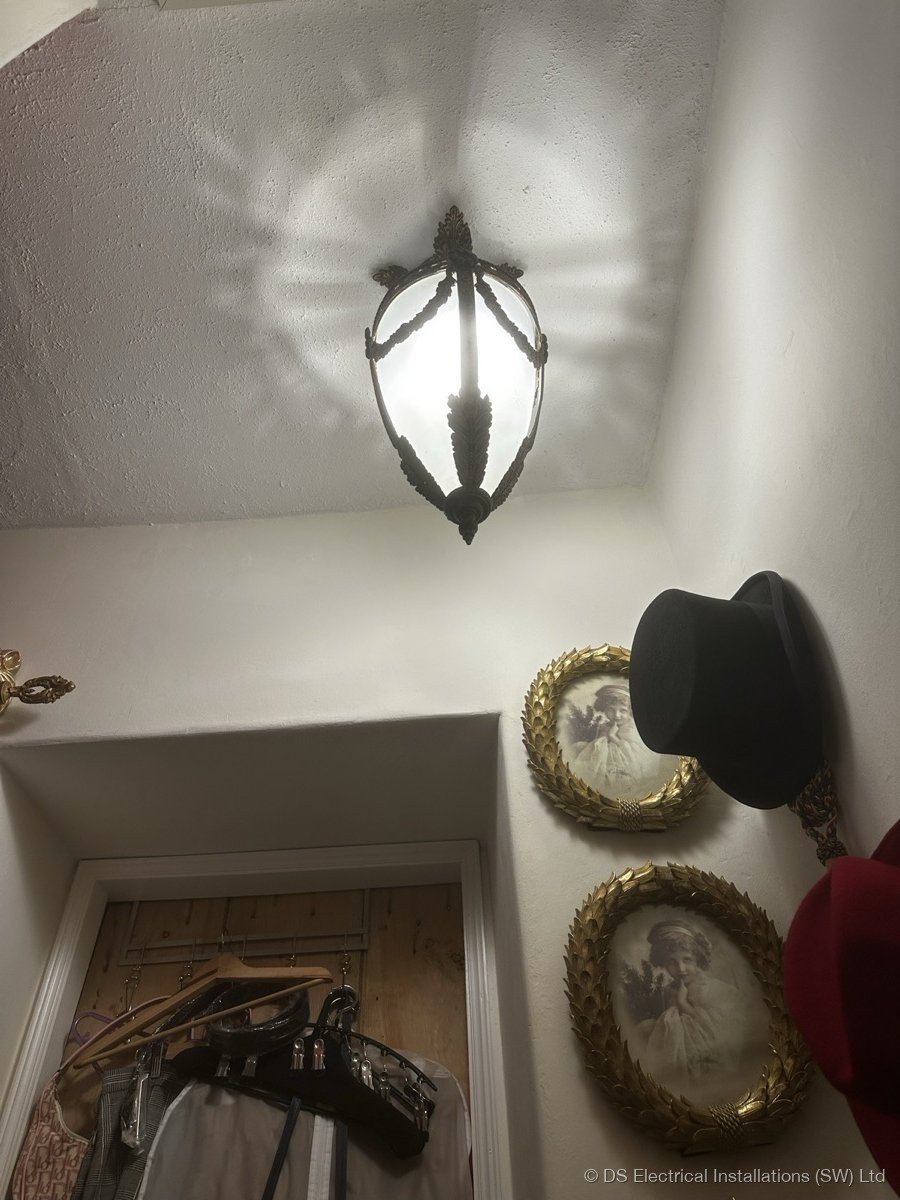
- Concealed LED drivers and dimmers, Modern dimmer modules hidden inside existing back boxes or in ceiling voids, driving period pendants and wall sconces. The fitting visible in the room is unchanged; only the electronics are updated.
- Heritage-format emergency lighting and fire detection, Small-profile emergency fittings and fire detection devices designed for listed building use are routinely approved in commercial and public buildings. We work with manufacturers who produce heritage-profiled devices specifically for this purpose.

What Will Typically Be Refused
Common Reasons for Refusal
Chasing original plaster: Cutting channels through original lime plaster for cable runs destroys irreplaceable historic fabric. Conservation officers almost always refuse this. Surface-run cable in sympathetically specified micro-conduit, agreed with the officer in advance, is usually the acceptable alternative.
Surface-mounted modern trunking on decorative surfaces: White or grey PVC trunking on decorative plasterwork, oak panelling, or dressed stonework will be refused. Brass or copper trunking, or concealed micro-conduit, may be negotiated instead.
Modern white or chrome sockets in period rooms: Flat-plate white switches and brushed-chrome sockets are incongruous in a Georgian drawing room or a Victorian church vestry. Our default recommendation is period-correct brass or antique bronze in any room that retains original finishes.
Drilling through historic masonry without consent: Any penetration of original stonework or brickwork for cables or conduit requires advance justification. We plan routes to avoid this wherever possible, and where it cannot be avoided we document and specify the reinstatement approach in the LBC application itself.
Our Approach: Working with the Conservation Officer
We never wait until a project is on site before thinking about consent. Our process for every listed building enquiry follows these steps:
- Pre-application discussion, Most local planning authorities offer free pre-application advice. We help you prepare the technical case for what you want to achieve and why the proposed approach is sympathetic to the building's character.
- Heritage impact statement, For significant schemes we produce a brief written statement explaining what is proposed, why it is necessary, what materials will be used, and how the work could be reversed in the future if required.
- Specification of period-correct fittings, We source from heritage-specification suppliers as standard for listed building work. All fittings are specified and agreed before LBC is submitted, so you are not waiting on procurement after consent is granted.
- Installation to BS 7671 and the conservation brief, Our electricians are fully briefed on each project's constraints before they arrive on site. If something unexpected is encountered, concealed original fabric, for example, work stops and the conservation officer is consulted before proceeding.
- Full certification and registration, An Electrical Installation Certificate is issued and registered with NAPIT and Building Control. You have a complete paper trail for insurance, sale, and future works.
Frequently Asked Questions
Does all electrical work in a listed building require LBC?
Not necessarily. Like-for-like replacement of fittings that does not affect the character of the building, replacing a failed socket with an identical one in the same position, for example, is often classed as routine maintenance and may not require a formal application. However, if you are running new circuits, moving switches or sockets, adding new lighting positions, or penetrating any original fabric, you will almost certainly need consent. If in doubt, a pre-application conversation with your local planning authority costs nothing and protects you from enforcement.
How long does a Listed Building Consent application take?
The statutory determination period is 8 weeks. In practice, straightforward applications supported by clear drawings and a heritage impact statement are often decided in 4-6 weeks. Pre-application discussions significantly increase the likelihood of first-time approval and reduce the overall time from idea to consent. We factor the LBC timeline into every project programme we prepare for listed building clients.
Do I need a specialist contractor, or can any electrician do this work?
Any NAPIT or NICEIC registered electrician can carry out the electrical installation legally. However, navigating the LBC process, specifying sympathetic fittings, and designing cable routes that avoid harming historic fabric requires genuine experience of heritage projects. An electrician who has never worked in a listed building may not know what to ask a conservation officer, or when to stop and seek guidance. DS Electrical Installations (SW) Ltd has carried out listed building wiring projects across Mid Somerset and surrounding areas and understands both the planning and technical requirements. See our client testimonials and project gallery for examples.
What about a domestic rewire in a listed building?
A full domestic rewire in a listed building is possible, but it requires careful route planning from the outset. Chasing walls is rarely an option, so cable routes must be threaded through existing voids, run within original skirting and architrave rebates, or accommodated within sympathetically specified surface conduit. We prepare a detailed routing plan before submitting the LBC application so you know exactly what to expect.
Why Choose DS Electrical Installations (SW) Ltd for Heritage Projects
- NAPIT Approved, all work self-certified and registered with Building Control under Part P
- City & Guilds qualified, 18th Edition wiring regulations, inspection and testing
- Heritage project experience, churches, listed farmhouses, Georgian townhouses, and barn conversions across Mid Somerset and surrounding areas
- Period-correct sourcing, brass, Bakelite-effect, and antique bronze fittings specified and supplied as standard
- Local coverage, Bath, Wells, Frome, Shepton Mallet, Midsomer Norton, Street, Radstock, Castle Cary, Bruton, Wedmore
Common questions
How long does a Listed Building Consent application take?
The statutory determination period is 8 weeks. In practice, straightforward applications supported by clear drawings and a heritage impact statement are often decided in 4 to 6 weeks. Pre-application discussions significantly increase the likelihood of first-time approval and reduce the overall time from idea to consent. We factor the LBC timeline into every project programme we prepare for listed building clients.